1.
July 1944, Normandy Countryside
The Focke-Wulf circled the makeshift bunker in a lazy arc, preparing for the next strafing run. The first attack had killed four of the seven men inside. The other three—Boyer, Steinberg, and Kelly—huddled at one end, in an area the depth of a shallow grave, with only a thin tarp above them. A narrow slice of sky was visible. Kelly groaned. He’d caught a piece of metal in his ankle.
Steinberg looked at the dead men slumped in the other end of the bunker, a cluster of tangled arms and legs and torsos, pockmarked with bullet holes. He’d been with the squad for less than a week and barely knew their names. One man’s eyes were wide open, as if he still didn’t believe what had happened. Another’s head was tilted back so sharply that it looked as if it might snap off. Steinberg crawled over and propped up the man’s head with a rucksack. The hair was sticky with blood, and all the bodies smelled of urine and feces. Steinberg watched an insect crawl over the man’s face. He pinched the skin between his fingers and forced down the gorge rising in his throat.
“Steinberg, forget that—he’s dead. Over here.”
Steinberg scuttled back to the open end of the bunker and crouched next to Boyer. He chanced a view of the sky through the gap in the tarp. The German plane was beginning a second approach. Gasoline fumes filled his mouth. Boyer said something, but Steinberg couldn’t hear him over the engine’s whine.
The plane was less than five hundred yards away when black smoke began to pour from its engine. Seconds later, it burst into flames. The propeller froze, and the sky went silent except for the hiss of air over the plane’s wing tips. It glided downward, so low that Steinberg could make out the numbers painted on its underside, then plunged on its belly into a hay field a few hundred yards away, plowing a deep furrow into the ground before it came to a stop.
After several moments, Boyer rose to his feet. He hoisted his rifle over his shoulder. “Steinberg, on your feet.”
Kelly jerked his thumb toward Steinberg. “You’re gonna take him? Geez, Boyer. The kid just got here three days ago. He doesn’t know his ass from his elbow.”
“Yeah, well, he’s gotta learn sometime, and I ain’t going up that hillside by myself. Steinberg, move your ass.”
Kelly said, “No, I’ll come.”
Boyer put his hand on Kelly’s chest. “Not on that ankle, Jimmy. Just stay put. I’ll see what’s what. Come on, Steinberg.”
“Yes, sergeant.” Steinberg got to his feet. He tensed his quadriceps, trying to still the shaking in his legs and hoping that Boyer would think he was ready for this, even though he wasn’t. “But, Sergeant Boyer, the plane crashed. Why would we go up there?”
Boyer shot Steinberg a scornful look, his mouth in a hard line. Too late, Steinberg realized he should have kept his mouth shut. Now Boyer thought he was a coward.
“To see if the bastard’s dead or has some info on him. It’s called investigating, dummy. Now move.”
Steinberg groped on the dirt around his feet. “I’m just looking for my helmet.”
Boyer walked purposefully, like a hunting dog intent on retrieving a bird. Steinberg stumbled along behind, his helmet banging on his forehead, the chinstrap hanging loose. He had to trot to keep up. Halfway to the smoking wreckage, he realized he’d forgotten his rifle. If there was any trouble up ahead, he’d be worthless. But he said nothing. Boyer already thought he was useless. He could imagine the contempt on the sergeant’s face.
The field rose at an angle away from the bunker. Boyer got to the wreckage a few yards ahead of Steinberg. He stood over the pilot, who had managed to crawl several feet from the smoldering plane. His boots were off, and his feet trailed blood in the dirt. He kept inching along, as if he were trying to escape, using his elbows to propel himself forward.
It was the first time Steinberg had seen a German up close. Smooth face, curly brown hair—he looked like Robert Caulkins, a kid in Steinberg’s eleventh-grade history class. Steinberg was supposed to hate all Germans, but this was another human being lying here, dying, every hope or dream he’d ever had dissolving in a pool of blood. Each time he moaned, Steinberg winced.
“Fucking kraut.” Boyer pointed his rifle at the pilot.
Steinberg waved his hands. “Wait!”
Boyer raised his rifle. “What?”
“Are you…are you just gonna shoot him?”
Boyer snorted. “I ain’t gonna kiss him.”
The German turned his face toward them. “Bitte… Bitte…”
“But, sergeant, aren’t we supposed to take him prisoner?”
“Prisoner? Wake up, asshole! This guy just killed our buddies.”
“But you can’t just shoot him, like a wounded dog. He’s helpless.”
“Helpless? You want to help this piece of shit who killed our men? My men?”
The pilot rolled over on his side with his back to Boyer, as if his leather jacket would shield him.
“Look at this gutless bastard! The piece of shit’s squirming like a worm. Watch and learn, soldier.”
“Wait, wait! Can’t you see the guy’s suffering? You said we were coming up here to investigate. To see if he has any info, that’s what you said. If you kill him, you won’t get info from him. And what good will it do? Look at him. The poor guy’s half dead already.”
Then the pilot rolled back toward them, clutching a Luger in his bloody hand. He grinned and fired. A cracking sound pierced the distance between them. A black hole appeared in Boyer’s forehead, and he toppled backward.
Steinberg said, “Boyer? Sergeant Boyer?”
Nothing.
He turned toward the pilot, who was now pointing the Luger at his face. Steinberg stared at the hole of the gun barrel. He smelled the gunpowder, imagining the bullet that was to come. “Please. Don’t shoot.” His bowels clenched; acid rose in his throat. As he locked eyes with the German, a mild breeze ruffled the grasses around them. It seemed almost an intimate moment, just the two of them, nothing else in the world.
He could barely get the words out. “Please…bitte?”
The pilot sneered, blood on his teeth. He started to speak, but blood pulsed from his mouth. His chest heaved, and he flopped onto his back, his eyes rolling back in his head. He wheezed and gasped. His arms flopped and flapped for a few seconds, then stilled. The sneer remained on his face.
Another voice came from the direction of the bunker. “Boyer? Steinberg?”
Steinberg looked back. He couldn’t see Kelly over the rise in the ground, but from the sound of his voice he had to be close. He’d be on top of Steinberg any second now, demanding to know what had happened. And what was Steinberg going to tell him— that he’d distracted Boyer, giving the pilot a chance to shoot him? That after Boyer got shot, he himself had just stood there, frozen in fear, pleading for his life?
Boyer was dead. There was nothing Steinberg could do to save him. What difference did it make now what was said?
Steinberg willed his legs to move forward and stepped over Boyer’s body. The strength of the pilot’s grip surprised him, but even with the German’s blood running over his own hands and wrists, he managed to untwist the man’s fingers from the Luger.
The pilot lay there, mouth open, teeth and tongue red. Steinberg thought he detected a slight movement. Was it the breeze, or was he still alive? That fucking sneer.
Steinberg leaned over, triggered the Luger, and fired into the pilot’s eye. The recoil jarred his wrist. He squeezed the trigger again, and kept firing into the pilot’s chest until the clip was empty. But the bloody sneer remained. He kicked the man in the teeth.
“Steinberg. Hey, Steinberg!”
Kelly’s voice sounded muffled and distant. Steinberg turned and watched him limp closer; he was moving toward Boyer’s body. “Oh no, oh no. Boyer…Boyer? Help me get down, Steinberg.”
He leaned on Steinberg’s arm, then dropped to his knees. He touched the bullet hole in Boyer’s forehead, put his ear to his chest. “Geez, he’s gone.” He looked up. “Jesus Christ, what the hell happened?”
Steinberg swallowed. He had never been so thirsty. “The pilot surprised us. He shot Boyer.”
Kelly looked at the hole in Boyer’s forehead, then back to Steinberg. “Shot him? With that Luger you’re holding?”
Steinberg glanced at the bloody gun as if he were noticing it for the first time. “Yes.”
“Wait a minute. How the hell did you get it?”
For a second, confusion jammed Steinberg’s thoughts. He looked at the Luger again; it had suddenly become his companion, his accomplice. “I took it from him.”
“You took it from the pilot? You took it?”
“Yes.”
“All those pops I heard.” Kelly turned to the pilot’s body. “Christ! One through the eye, the rest in his chest. You did this? But how the hell did you get the Luger away from him?”
“I just… Oh God, poor Boyer.” Steinberg’s head slumped to his chest. “Kelly, this is my fault. I forgot my rifle.”
“But Boyer had his. It’s right here. I don’t get why he didn’t shoot the rat bastard straight off.” Kelly frowned, then shrugged. “At least you killed him. Boyer would have appreciated it.” He used Boyer’s rifle for a crutch and got to his feet, staring all the time at Steinberg as if something didn’t add up, but he couldn’t put his finger on it. “Don’t take this the wrong way, but I didn’t think you had it in you. I guess you’ve got some balls after all.”
Steinberg shoved the Luger into his pocket. He rubbed his hands together over and over. “Kelly, I can’t get the blood off.”
“Here. Hold them out.” Kelly opened his canteen and poured water over Steinberg’s hands.
Steinberg wiped them on his pants. “Thanks.”
Kelly lit a cigarette and held it out to Steinberg. “Here. Take this.”
Steinberg coughed on the inhale. “Thanks.”
“Geez, poor Boyer. Never thought he’d let a Kraut get the drop on him. Fucking shitty way to go.” Kelly bent again over Boyer’s body and removed his dog tags and wallet. “Listen, I need you to hump your ass down to the bunker and bring me the field phone. I gotta call in. And bring Burgess’s camera back with you.”
“The phone and the camera.”
“What’d I just say? Don’t just stand there. Move! Chop, chop.”
Steinberg followed the furrows in the ground that led back to the bunker. His ears still rang from the gunshots. His hands were still sticky with the Germans’ blood. Flies flitted around him. Even as he went downhill, his lungs burned with the effort. The midday sun seared the back of his neck, and sweat rolled down his face and stung his eyes. He stumbled over a field stone, ripping his pants and bruising his knee. Every so often he looked up at the sky, terrified that another plane would come by to finish the job.
Eventually he stopped to catch his breath and looked back toward the wreckage. Had Kelly believed him, or had he seen through it all?
Finally Steinberg reached the bunker. The air was fetid and hot. He had to crawl over two mangled bodies to get to Burgess; the camera was strapped across Burgess’s chest. Steinberg brushed flies away from the wound in Burgess’s neck, but almost immediately they returned. He had to shift Burgess’s body around to take the camera. The limbs had already begun to stiffen.
Steinberg’s stomach heaved. A bitter taste rose in his mouth, followed by a spew of vomit. He found a canteen, swished a mouthful of tepid water, and spat. He wished he had one of the hard candies that his mother always put in the candy dish on their coffee table. “For a sweet life,” she would say. Oh, Ma, if you could see me now.
With the radio and camera slung over his shoulders, he stumbled back to the plane wreck.
“Steinberg, are you all right? You’re as white as a ghost.”
“I got a little sick to my stomach down there, but I’m all right now.”
Kelly took the camera and shot photos of Boyer and the German. Then he motioned toward the wrecked airplane. “Climb up there and I’ll take your picture.”
“Climb up on the wreck?”
“Go ahead. Take your Luger.”
Steinberg clambered over hunks of twisted metal until he was standing near the tail wing. He rested his left hand on the wing tip, almost touching the massive black swastika. He took out the Luger and let it hang from his right hand. With his jaw set in a straight line and his brows furrowed, he hoped he looked like a man to be reckoned with. “How’s this, Kelly?”
Kelly flashed him the thumbs-up sign. “Perfect. You look like a hero.”
2.
Steinberg walked between rows of wounded Americans in the field hospital, a short jeep ride from the barracks. The air was thick with the smell of disinfectant and urine. His calves twinged with sympathy pains as he passed dull-eyed men with pasty, unshaven faces—men with bandaged feet hanging off the ends of their cots; men trying to read; men slumped forward, elbows on their thighs. All young soldiers like him, trying somehow to bear their misery.
One, with a cigarette hanging from his lower lip and a bandage wrapped around his head, had yellow stains where his eyes should have been. Another had stumps for legs, encased in red-splotched gauze; he gazed at a Bible resting on his chest while a nurse changed his dressing.
Steinberg walked on, searching for Kelly. He tried to keep his gaze focused straight ahead, but every so often a wounded man caught his eye and he felt a surge of guilt that he was whole and unscathed. Boyer, Burgess, and all the other men in his squad were dead. Why wasn’t he?
He found Kelly at the end of the row. His right leg was elevated, attached to a hoist. The bandage around his ankle was the size of a cantaloupe. His eyes were closed, but his chest rose and fell, a sign of life.
A nurse came by the bed. Steinberg said, “How is he?”
“Him? He’s a real pain in the ass.”
Kelly stirred awake. He blinked a few times. “Steinberg?”
Steinberg saluted.
Kelly’s face broke into a wide grin. “Well, if it ain’t the conquering hero! I’d have laid five to one you’d be mincemeat by now.”
“I just keep my head down.”
“More likely up your ass. Christ, Steinberg, look at you. You almost look like a real soldier.”
Steinberg held out a paper bag. “Hey, I brought you a present.”
The nurse poked her head over his shoulder. “If the thing in that bag is what I think it is, soldier, you’re in violation of hospital rules.”
Kelly said, “Come on, Millie. It’s just a bottle of soda pop in there, right, Steinberg?”
Before Steinberg could answer, the nurse said, “You know, I could have you escorted out of here for bringing in booze. But what the hell—there’s a war on, right? I’ll pretend I didn’t see. Anything to shut up this one.” She turned to leave, then stopped. “Next time, soldier, bring a paper bag for me too.”
“You’re a peach, Millie.”
Two beds down, a man with a patch on one eye and a cast on one arm banged a metal cup on his bed railing.
“Hold your water, I’m coming!” said the nurse.
Steinberg pulled up a folding chair next to Kelly’s bed. He slid the paper bag halfway down the pint bottle, far enough to show the label—Seagram’s 7. He passed it to Kelly, who unscrewed the cap and sipped.
Color rushed into his face, as if the liquor had been a blood transfusion. His eyes grew watery, either with the alcohol or with gratitude. “This is the best present I ever got.”
“It’s not all for you.” Steinberg reached for the bottle, took it, and sipped. The peppery burn reminded him of the times when he and his brother had stolen nips of their father’s Seagram’s. It made him ache for home, ache to forget the intervening years.
“Steinberg, if you ain’t gonna drink, pass it back.”
“Sorry.” Sharing liquor was one bond. But what had happened in the bunker and on that hill connected them in a more fundamental way. “Jimmy, how do you feel?”
“Better, now that you’re here.” Kelly sipped more whiskey. “Truth is, the ankle’s gone from bad to worse. Got infected twice. Good thing these hacks stopped it before it spread too far; otherwise they’d have taken off half my leg. But I ain’t so bad. Look at the rest of these bastards. They got it worse than me. All the moaning and crying, I can’t hardly sleep.”
Steinberg tried to imagine how long and miserable the nights must be, listening to the wails and cries of these poor men, sweating it out against the pain as the hours crept by until morning light and the next painkiller. It was amazing that Kelly had kept it together at all in here. He said, “No wonder you were asleep when I came in.”
“Yep. And not only that. When I hear the Bog Berthas rumble, I realize there’s still a war going on out there, and there’s not a goddamn thing I could do to save my life if this hospital were hit. I’m a goddamn sitting duck here. Hey, how about that smoke?”
Steinberg lit two cigarettes.
“Damn, Steinie, drinking and smoking and killing Nazis? I must be a bad influence.”
“Damn straight.”
Kelly exhaled slowly. “Like I said, I got a lotta time on my hands. I keep thinking about Boyer and that German.”
The back of Steinberg’s neck prickled. Did Kelly suspect something? Forcing his voice to remain cordial, he said, “What do you mean?”
“What I’m thinking is, here’s Boyer, a tough guy, seen a lot of action. He’s the last guy I ever thought would let his guard down.”
Steinberg’s mouth was dry. “Yeah?”
“And here’s you—green as a grasshopper. Scared shitless back in the bunker. Don’t tell me you weren’t, I saw your face.”
“We were all scared.”
“Even so, you were so shook up by the strafing, you didn’t even remember to take your rifle. I’m still trying to figure out how you got the gun from that German, barehanded.”
Steinberg’s thoughts whirred. “I don’t know how. He had the drop on me, and I guess…I guess I just didn’t want to die like that, so I rushed him. He looked surprised, like I was crazy. I got hold of the Luger, and I wouldn’t let it go.” Steinberg took the gun from his jacket pocket. “See? Still got it.”
Kelly straightened up. “Christ, put that thing away!”
Steinberg slid the Luger back in his pocket. He felt in control again. He was imagining the scene as he spoke. “I just felt like there had to be payback for Boyer. After I got a hold of the Luger, I pointed the gun at the Kraut’s eye. You know what he said before I shot him? He said, ‘Bitte.’ Please.”
A man two beds away shouted, “Hey, pipe down!”
Steinberg lowered his voice. “So that’s how it happened.”
“Yeah. Okay.” Kelly tapped ashes on the floor. “Hey, is that Burgess’s camera?”
“Yeah. After the medics took you away, I grabbed it for safekeeping.”
Steinberg had started keeping the camera with him night and day. It still contained the undeveloped photos of Boyer with the black hole in his forehead, of the German with his eye shot out, of the dead men in the bunker. It felt heavy with all those bodies.
“So how come you still have it?”
“Well, I need to get the film developed. Once I finish the roll.” Steinberg forced a laugh. “The army wouldn’t want me to waste good film.”
“Fuck the army. When you do get it developed, will you send me a copy of the one with you standing on that plane?”
“Really? Why?”
“I just want to remember the scene of the crime.” Kelly groaned. “Goddamn ankle.”
“Should I get the nurse?”
“Nah, she won’t give me anything until it’s time for my next pill.” He propped himself up against his pillow. “So where have they assigned you, now that the squad’s been blown to kingdom come?”
“A supplies unit. I load and unload trucks. It’s not too bad. Sometimes I get to type up the requisitions.”
“Sounds cushy.”
“I’m probably the only guy in the unit who took high-school typing.” Steinberg shifted in his chair. “Did they tell you when you’re getting out of here?”
“They don’t tell me shit. But you can bet your ass, unless this ankle gets better fast, they won’t send me back into the field. I wish they’d send me home.”
“Back to Boston?”
“Yeah. But I ain’t staying there. I’m going to head out to California.”
“Huh?”
“Here’s the deal. Assuming I get back alive, as soon l can afford a used car I’m hightailing my ass out to LA. Babes, beaches, palm trees, Hollywood—just like they show it in the movies. My cousin Johnny went out there years ago and landed a job at one of the studios. He’ll put in a good word for me until I get on my feet.”
“But I don’t get it. Why do you want to leave home?”
“Listen, I could stick around South Boston, be a townie for the rest of my life. I ain’t knocking it. But I don’t wanna be just another guy hanging out on the street corner. Getting wounded was a wake-up call. Why not give life a shot? What do you think, Steinberg? You wanna come with me, or are you planning to spend the rest of your life in the Smoky City?”
“Well…California sounds pretty sweet, the way you describe it, but I don’t know. What would I do while you’re becoming a movie star?”
“You’re smart. You could go to college out there. Isn’t that what you people do?”
“College? What would I study?”
“How the fuck should I know? I barely made it out of grade school. All I ever had going for me was a stiff jab and a sneaky left hook. But now, unless this bum ankle somehow gets fixed, my boxing days are done. You, though, you’re smart. I hear your people run most of Hollywood. I bet they’d hire a smart Jewish G.I. like you in a second.”
“I don’t think it works like that.”
“But how do you know? You people take care of your own, don’t you? Nothing wrong with that. Hell, if I thought it would work, I’d tell them I was a member of the tribe—Jimmy Cohen. And just wait until they hear you killed that Nazi barehanded.” Kelly groaned again. “Just think about it, all right?”
—
Author’s Statement
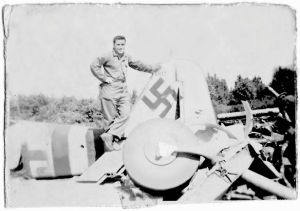 THE LUGER is based in part on my father’s experiences in World War II. The photo shown here is of him standing on a shot-down Nazi fighter plane, somewhere in France, after D-Day. But I don’t know much more than the facts revealed in the image. He would never talk about the photo or about anything else regarding his time in the war. My father is Jewish, and this has added a powerful layer to the story I’m imagining.
How did the plane crash? What happened on that hillside after the crash? How did the man in the photo—who, in the novel, is a character quite different from my father—get up on the plane? Who took the photo?
I could have made the man on the plane into an all-American hero who shot down the aircraft and killed the pilot who survived the crash. That isn’t what happens in the story I’ve written, but that’s the way the main character, Sandy Steinberg, chooses to tell it. He returns home after the war and fabricates a story of his heroism—how he and two soldiers in his squad survived a strafing from the Nazi plane; how he shot down the plane with a one-in-a-million shot; how he and another soldier investigated after seeing the plane crash in a field; how the pilot killed Steinberg’s friend with a Luger, and how Steinberg took the Luger away and killed the pilot in turn.
He becomes a hero to family and friends. The Jewish community proclaims him a modern-day David who defeated the Nazi Goliath. His uncle tells him that God Himself wants Steinberg to tell his story.
Ultimately, however, the hero takes a fall. Steinberg’s story is exposed and discredited by the only person who knows the real truth, Corporal Jimmy Kelly, who was there the day of the plane crash. Steinberg becomes a pariah in the community, but fate and faith provide an opportunity for his redemption, so that he can become the hero he pretended to be.
I chose this path because I believe the rise, fall, and redemption of an ordinary man is a story that appeals to the humanity in all of us.
Marc Simon is a writer who lives in Naples, Florida. His short stories have been published in several online journals and nominated for both the Pushcart Prize and inclusion in Best American Short Stories. His first novel, The Leap Year Boy, was published in 2012. Recently he published a novella, According to Isaac, on Amazon. For more information, visit his website: marcsimonwriter.com.
Embark, Issue 24, April 2026
 Embark