1976: Crossroads
Huron Street, Toronto
I’m posing on the bed while Rory sits in the carved wooden chair he’s been careful to bring with him as we move from place to place. He’s drawing in a large sketch pad.
“I was wondering if the ache in my back was my kidney disease returning,” I tell him. I want to ease into some major news. I’m unsure what his response will be.
“You think it is?”
“I did at one point, but not now.”
I’ve just returned from a brief, unhappy visit to my childhood home. Nothing has changed there. My relationship with my mother seems to be irreparable, and that’s a huge disappointment. I still remember standing by the door to the kitchen at age five, feeling desperate to interact with Mom. It was impossible. She had Karine in her arms as she stirred something on the stove, and Lorne cried and pulled on her skirts. Even that young, I recognized that she was torn in too many directions. There was nothing left to give to me. I didn’t hold it against her. She and I were simply in a constant state of disconnect. But the root of our current troubles is different. I was entering my teen years when a car accident changed her ability to cope with the demands of everyday life and I lost her altogether.
“Mom made a few snide remarks to me. I let them slide by. Then she saw me rubbing a sore spot in the middle of my back and said, ‘You’re pregnant again.’ I told her, ‘Impossible. I’m on birth control, and I still have my period.’”
Rory has stiffened, though it’s almost imperceptible.
“She insisted she knew what she was talking about. I didn’t agree, but I called my doctor and made an appointment.”
“And the doctor said?” He’s wearing a blank expression.
“She confirmed Mom’s suspicion. I’m pregnant.”
“But how? You have an IUD!” He scowls.
“Apparently, one in one hundred women can still get pregnant with an IUD.”
“Well, it doesn’t matter. A studio’s no place for a baby.” Offhand. Dismissive. He won’t let science, or proven exceptions to the rule, tip the position he’s taken.
That comment, released so easily, catches my ire.
“Tell that to Picasso!” I snap. Then I pull into myself, to regain control. “Picasso sat on the floor with his children, encouraging them to paint. The first time we met, we talked about him being in his nineties and having a son in his early twenties. Remember?”
Rory ignores this, continuing with his painting.
I place my index finger on my chin, casting my eyes toward the ceiling. “Maybe Monet should have known babies don’t belong in a studio! You know he painted his children. But wait, Matisse used his children as models too. And let’s see, Renoir and Gauguin both painted their babies. Do you think any of them told their lovers that babies don’t belong in a studio? I doubt it.” I’m silent a moment, before I reveal a long unspoken truth. “I need you to know something, Rory. I still ache over giving up Robin. I miss our boy, every day.”
Naming the child gives us both pause. It’s a name that came from my heart, when Rory refused to be a father three years ago. We were both seventeen then. I wanted our baby to have a safe home with two parents. I didn’t plan to get pregnant, then or now. After Robin was born, when it was clear that withdrawal didn’t work, I got an IUD. Despite the statistics, my doctor is as surprised as I am that my IUD didn’t prevent this pregnancy. She’s investigating what to do, consulting with medical experts: leave the IUD in, or remove it?
“I can only repeat myself, Elke. All of my focus goes to my painting. If you give this baby up, I’ll stay with you. I have no say in whether you abort it or give it to CAS—but if you keep it, I can’t promise I’ll stay. I’m not the fatherly type.”
“I can’t give up another baby, Rory! You played a big part in this. It shouldn’t all fall on my shoulders to deal with my pregnancy.”
“It doesn’t all fall on you. I’ve told you my conditions. You’re on birth control for a reason.”
“I don’t need you to tell me that! Obviously we’re in this situation because birth control isn’t one hundred percent effective. We accept a level of risk every time we make love, don’t we?”
He’s standing with his back to me. I wait, but he doesn’t turn around or speak again. I let the issue rest. Part of me hopes he’ll grow into the idea of being a father over time. After all, being twenty is a lot different from being seventeen. I wonder how other couples have dealt with this situation. Do they always fall apart, facing a surprise pregnancy?
Several weeks pass. Nothing more is said about the child who’s developing at my core. I begin to think that Rory might change his mind. We still make love almost every night. We carry on. I still model, even as my belly begins to pouch.
One day, I realize I’m past the magical date of no return for aborting a pregnancy in Canada: seventeen weeks, almost four months. I can no longer obtain a legal abortion. And despite a rough start, Rory and I have remained more than civil. He’s been loving, actually.
*
Rory’s in our bedroom/studio, painting. I’m getting ready for my job at a switchboard-style telephone company. He works at Grossman’s Tavern, recently graduated to bartender from fetch-it boy. Today is his day off, and he’s under-painting from sketch notes. He doesn’t need me to pose.
“Remember Calvin?” he calls out. “From high school? The tall guy with bangs in his eyes. Shy, but always playing pranks.”
He comes to the door between the rooms, watching me for my reaction. I’m preoccupied, putting on make-up at the mirror over the kitchenette sink in this awkward rental. We have two rooms with a shared bathroom down the hall.
A half laugh slips out of me. “I remember Calvin as a class clown: gawky, always seeking attention, very bright…the sort people label a nerd. You’d laugh at his jokes.”
“Well, he’s moved to Toronto, and he’s invited us to a party. I ran into him on the sidewalk at Spadina last night, coming home. He’s on Madison Avenue. I didn’t know he was in town ’til I saw him. He said it’s a house-warming slash Halloween party. I think he wants to show off his new woman.”
“It doesn’t seem as if Toronto is a place where Calvin would fit in, does it? He’s really klutzy socially. What day of the week is the party? You know I work nights.”
“That’s what I thought. Friday, two days from now. I guess we can’t go.”
“Well, I can’t make it, but why don’t you go?”
“You have to work. He invited both of us.” Rory turns back to his painting.
“Calvin will understand why I’m not there. Other people have jobs that run late. Tell me you’ve got something more important lined up. Come on, Rory: it’s a party with an old friend you haven’t seen in years.”
He breathes in deeply, choosing not to bite on my challenge. “Calvin has always been an odd-ball. He used to gross us out at lunch with awful nicknames for the filling in his sandwiches. Remember? I wouldn’t be surprised if his girlfriend looks like a goat.”
“Okay, you’re being crude now. Don’t go if you’re going to take that attitude with you.”
“Oh, I can be polite.”
“I should hope so.”
*
At midnight, I take a taxi home from work. It’s Halloween, and I figure a taxi will be safer than the bus or the subway, just past the witching hour. When I get home, I don’t wonder why Rory isn’t back yet. Midnight is early for a good party to end, even though it’s too late for me to arrive. Besides, I’m tired. I fall asleep quickly.
I don’t realize that Rory hasn’t returned until Calvin phones to wake me at eight o’clock the next morning.
“Come meet me,” he pleads. He lets me know that something bad has happened but refuses to say anything more on the phone. He insists on meeting face to face.
I arrive at the cafe at 9:30. Calvin has already purchased two teas: one for himself, one for me. He sits on the outdoor patio, where he can watch for me, though it’s a cool first of November. We’re the only people sitting outside.
“I need privacy to tell you,” he explains.
I set my purse on the chair beside me and unbutton my coat as I sit. He passes me my tea, and I thank him, though it’s already gone cold. His bangs still fall over his eyes, but they’re longer now, hiding more of his face. Fuzzy grey ear-muffs contrast sharply with his shoulder-length hair and dark, thick-framed glasses. He hunches the shoulders of his coat close to his ears, staring at his hands as if he hopes to discover how to begin there.
I’m anxious and impatient. “Okay, Calvin. What do you want to tell me? Why didn’t Rory come home last night? Was he hurt?”
“I’m trying to think how to—”
He interrupts himself, waiting until people on the sidewalk pass by. His eyes follow a pigeon as it flies from the sidewalk to the café rooftop. He avoids looking at me, which feeds my anxiety. It’s easy to guess that something truly awful has happened.
The huge swirl in the pit of my stomach worsens as I wait for him to speak. I’ve run through various scenarios since his phone-call. I don’t know him well, but Calvin seems to be in shock. I wonder how badly Rory was hurt. Yet it doesn’t make sense. Calvin could’ve met me at the hospital—unless it’s worse than an injury. The voices that have guided me since I was a child, my inner thoughts, speak all at once, jangling my nerves. I can’t sort out their message.
“I’ve known Rory a long time,” he begins. “I didn’t think anything like this would happen.” He begins to cry, fat tears streaking his cheeks.
“What? What happened? Tell me!”
What could possibly result in both Rory’s absence and Calvin being this upset? His tears spark fears I never realized I had. I put my hands over his balled fists on the table. He looks directly at me for a moment, breathes in deeply, and begins.
“The party started out fine. There were lots of people. I thought everything was fine, until the others left.”
He pauses to compose himself. I take in his pallor, his unbrushed hair, and brace myself to hear the worst. I ask the voices in my head to hush. There are times when one’s intuition can seem intrusive. I don’t want to assume anything.
“Finally it was just the three of us: Meryl, me, and Rory.”
“Meryl is your girlfriend?”
I’m orienting myself, but my question starts Calvin sobbing again. He nods yes before shaking his head no. It sends a shiver down my spine. He’s giving contradictory messages. I’m confused, disoriented. My imagination is playing games with my emotions. I’ve still got no idea what Calvin is leading up to.
“Rory and Meryl started to flirt, right in front of me,” he chokes out. “It was just words at first. Then she moved over so she was almost sitting in his lap, one leg over his. Rory moved his arm along the back of the couch, around her shoulders, and she says—” Calvin gulps. He opens his mouth, almost panting for a few breaths. His voice cracks as he continues. “She says, ‘Rory and I are up for a th-threesome. How about you, C-Calvin?’ I couldn’t believe it. I looked from her to Rory. He just stares back at me, waiting for my answer. I’m shocked. No, I’m disgusted, horrified! ‘Close your mouth,’ Meryl tells me, just like that. Then she stands, takes Rory’s hand, and leads him into the bedroom—our bedroom. They left me there, sitting in the living room!”
“Christ!” This isn’t what I expected him to tell me. The voices whisper inside me. I ignore them.
“I don’t know if she expected me to follow them. Maybe she knew I wouldn’t.”
In my mind, Meryl leads Rory to a bedroom. I’ve never met her, so in my mind Rory follows a woman with no face. The fact that he’d do this while I’m pregnant tells me I’ve been a fool. Even after the deed was done, he made no effort to come home, no attempt to contact me. What cuts most deeply is the fact that I encouraged him to attend the party without me. It was an expression of trust on my part, a trust he broke. Slowly, anger overtakes my shock. But I also know that, whatever he fantasized, Rory needed a strong invitation to follow Meryl into that bedroom. That’s what Calvin is struggling with. He thought there was commitment between him and Meryl.
“This is so crass.” I shake my head, settling into my new reality.
“I couldn’t believe it!” Calvin blubbers. “I just sat there. I let it happen. I mean, I heard them in the other room all night, but I didn’t do anything! I was paralyzed.”
“What could you do?” I ask.
Calvin is silent. He’s still reeling. He’s barely touched his tea. It strikes me that he’s trying to discover his own guilty part in this. I understand why he wanted to meet at a café with outdoor seating now.
We commiserate for another ten minutes. My inner voices counsel me quietly. They’re a part of me, my conscience. They tell me I’m better off without this man in my life. Clearly, my time with Rory is over.
“I’ve got to go, Calvin. I’m sorry, but I need to gather myself before I get ready for work.” As I stand up, my unbuttoned coat opens to reveal my growing belly.
“Oh, my God, Elke! You’re pregnant!”
“Yes, five months,” I admit.
“And I didn’t do anything to stop them,” he moans. “You must be so angry with me! Now I feel even worse.” He’s latching onto my pregnancy to convince himself that he’s responsible for the actions of Rory and Meryl.
“Listen, Calvin. None of this is your fault. Who could imagine that anything like this would happen, just because you hosted a party?”
I’m already distancing myself from Rory, feeling resigned, preparing to forge a different future without him. In truth, I’ve been bracing myself for a break-up for months.
“I wish I’d never invited you guys. If he hadn’t come, I don’t think this would have happened.”
“Don’t you?”
Immediately, I regret those two words. Calvin’s face crumbles. He’s feeling crushed, crying again. He turns his whole body away so I can’t see his face. I realize that this probably isn’t Meryl’s first time proposing a threesome. If not Rory, she would have chosen someone else.
“I’m sorry, Calvin. I don’t mean to be harsh. It’s clear that neither of them was truly committed—to me or to you. Right? So better sooner than later—that’s my take-away. They were each going to leave us at some point. Maybe not with this much drama, but it would have happened.”
He turns back to me, his face streaked with tears. “I have to look for a new place. I can’t stay there. Rory isn’t leaving.”
“Don’t let yourself be a victim, Calvin. Their behaviour is on them, not us. You can do better than that woman. And I can certainly do better than that man.”
I hold out my arms and hug him goodbye. We embrace because it’s obvious that he needs reassurance. I want him to know he’s not responsible for what happened. Ours is an awkward hug between two people who probably won’t see each other again. We’re both shivering in the early November wind and the after-shock from the party. Then we go our separate ways.
*
My brother, Weylin, is floored when I tell him what happened. He reveals that he felt something changed in Rory after the news of my pregnancy, but he couldn’t put his finger on it. Talking to Weylin on the phone brings back our sense of companionship as kids.
A week later, we arrange to meet for coffee and step into a grocery store together afterward. As I’m gathering fruits and vegetables in my cart, Weylin goes in search of coffee. He returns just as I wonder where he’s disappeared to.
“You won’t believe who I saw at the checkout,” he reports. “Rory was there with Meryl. He saw you over here and actually implied that you were my partner!”
I’m so stunned I can only shake my head. “He’s doing a good job of being a creep,” I say. “Did you correct him?”
“To be honest, I was too surprised to speak,” Weylin admits. “Anyway, it was something he called back as they were leaving: ‘Say hello to your girl, Sharon, for me.’”
I’m disappointed that Meryl hasn’t awakened to how callous Rory can be, but his facility with lies no longer shocks me. My whole reality has seemed different in the past week. The voices have surrounded me with their succour. They tell me, Move on. Let him go, whether or not he’s messing with you.
Here’s the thing: Rory used to leave me notes to inform me of his plans. These days he doesn’t communicate, never leaves a note, but he keeps visiting the flat when I’m out. He knows my work schedule. It’s like living with his ghost. I’ll come home to discover he’s been there and left again. Sometimes he paints. Often he changes his clothes and leaves a dirty pile on the floor. He makes himself a sandwich and leaves the plate and cutlery on the counter. The book he’s reading lies open on a side table where he left it. It’s utterly callous, thinking he can step in and out of my life as smoothly as he enters and leaves the flat. I’ve phoned Grossman’s Tavern several times, but he never accepts my calls. Instead he forces me to live with this mirage.
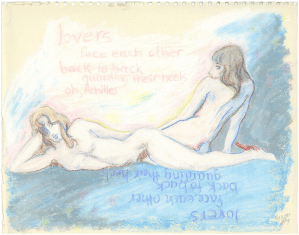 I hold no hope of regaining Rory’s company. Still, when I’m not at work, I can’t get my mind off my circumstances. I’ve just finished the second trimester of my pregnancy. I’ve reviewed my life with Rory, thinking fondly about how our partnership began. He was there for me when we first became model and painter. It was an equal exchange in the beginning, followed by the pain I dealt with alone after our son’s adoption. But we remained a committed team for art. We knew we’d rock the world, right up until I got pregnant again.
I’ve never developed a connection with anyone else like the one I made with Rory as a painter. We were instinct and inspiration in partnership. Still, my sense of well-being with Rory as a man was punctuated by problems for several months before he left. He knew I’d keep this baby, and it was a threat to his painting. He wasn’t willing to risk opening himself up to the joys of fatherhood.
*
Another week has passed. Rory continues to make sandwiches and tea in the flat. It’s a new month, but he hasn’t pitched in toward rent or groceries. This is a tease, holding our connection inches from my face, having his cake and eating it too. Maybe he hopes to convince me to give up our child, but I’m firm on keeping it.
I realize that nothing will shift until I force the end. Part of me saw it coming, though it seems more like an amputation with phantom-limb syndrome than a true ending. Who knew he had this much disregard for the well-being of others? Especially when one considers his stand on government, wars, and the mistreatment of poor populations around the world. I’m glad I never met Meryl. She and Rory deserve each other. They won’t last, the voices tell me.
Some people, when they read—and this is true for me—hear voices speaking the words of the different characters, with real emotion. But my inner voices involve themselves in all the events of my life, more than most people experience. As an adult, I no longer consider them the leprechauns or fairies I thought they were as a child.
This isn’t the first time Rory has behaved in an unexpected or hurtful way toward me, yet, this time, he’s forced me to realize I’m truly and forever finished with him. Several big events shaped the young girl I was and the woman I’ve become. Some were frightening, causing nightmares. Some were wonderful. Rory has been part of my journey, but some elements of our relationship were less than desirable. He’s changed over time. And since I revealed my second pregnancy, he’s ranged between silence and his original refusal of responsibility for fathering Robin.
*
I call Grossman’s Tavern ten times over a two-week period. Each time I ask for him, I’m told he isn’t there. I don’t believe it.
Today I walk in instead of phoning. As I pull open the front door, I see him sitting at a table with his workmates. His laughter quickly becomes a scowl when he realizes who’s approaching his table.
“I’ve got nothing to say to you.”
“I didn’t come here for an explanation. I came to tell you, if you’re gone, move out. Stop ghosting me and making dirty dishes. Stop leaving your dirty clothes on my floor. I’m not your maid. If we aren’t together, pack your stuff and leave.”
I pause. I’m so calm it surprises me. He looks at me in astonishment, opening his mouth as if he’ll turn the tables on me, but I continue: “I paid the rent all by myself three weeks ago. I put groceries in the fridge on my own dime. So give me your key to my place. You don’t live there anymore.”
I stand across the table from him with my hand held out, waiting. He won’t be able to resist my ultimatum in front of his workmates. They shift nervously in their chairs as he removes a key from his key chain and hands it to me without another word. I fold my fingers around it.
“I’m taking this Wednesday off work. You can move out on your day off.”
With that, I turn on my heel and walk toward the door of the tavern.
I’m sure my acceptance of our break-up has surprised Rory. His visits show his reluctance to make it final. Maybe he even took delight in acting like a phantom. But I’ve lived through trying times before. I had what many would call a difficult childhood, if not a nightmare—though, to be fair, my life has also contained a multitude of pleasures.
I look forward to balancing the ghosts of my experience, including those I’ve buried, with the potential of my future. I know I’ll be fine.
—
Author’s Statement
This is the story of growing up in Southern Ontario during the 1950s as a female and follows Elke Brix’s thinking and experiences as an artist’s model. The tale presents itself on two timelines, beginning with the end of Elke’s time as a model for Rory, followed by her childhood move to the private estate of Cedar Vale Girls’ School, where her father works as the school’s caretaker with a sideline in repairing machinery. The timelines switch back and forth throughout the novel to demonstrate how later situations can be influenced by childhood experiences.
Elke is raised in a home where her older brother, Weylin, takes over some of the responsibilities usually assigned to parents. Their parents are too busy to notice when their children begin hiding traumatic secrets. When Weylin matures and leaves the house, though she stays in touch with him, Elke becomes even lonelier. Her mother’s injury from a car accident causes greater friction, and Elke runs away from home, landing at the flat her brother shares with two young painters.
Elke falls in love with a tall redhead named Rory, not just for his gentle nature but for his goals as a painter. He believes, as she does, that there is too much violence in the world. Living in the flat, they are soon haunted by a shadow man, who turns out to be a violent poltergeist. Rory believes the poltergeist was sent through a spell cast by his ex-girlfriend.
They seek their own place to escape the poltergeist and develop a unique symbiosis, to the point where Elke can “see” what Rory sees and begins to wordlessly adjust her pose for Rory’s paintings and drawings as needed. They’re surrounded and inspired by the creativity of their friends, who often visit their studio for discussions of politics and art. But they also entertain a few unwelcome visitors that cause Elke to request a move to a larger city.
What Elke doesn’t expect is the way that, over time, Rory’s goals as a painter gradually crowd out his connection to other people, so that he becomes something of a creative monster. After being forced to give up one baby for adoption, she discovers how he responds to her creativity, not only as a writer and artist but as a mother. She also learns that secrets can be as damaging as an untruthful relationship, and eventually realizes that Rory is not the man for her.
In the end, she decides to live her life openly as a woman resisting the patriarchy, but most importantly as an artist, a writer, and a mother.
Sharon Berg is a publisher living in Charlottetown, Newfoundland. Her work has appeared internationally (in Canada, USA, Mexico, Chile, England, Wales, Amsterdam, Germany, Romania, Siberia, India, Persia, Singapore, and Australia). Her poetry collection Stars in the Junkyard (2020) was a finalist for the 2022 International Book Award, and her book The Name Unspoken (2019) won a 2020 IPPY Nonfiction Award. She is the founder/publisher of Big Pond Rumours Chapbook Press.
Embark, Issue 25, October 2026

